
Aerial Lift Maintenance Checklist
December 23, 2024
Industrial aerial lifts are invaluable tools, and their efficiency and safety rely heavily on regular maintenance. As an aerial lift owner or operator, scheduling routine protocols like inspections, operator training and breakdown prevention can ensure your crew’s safety and your equipment’s longevity. Maintenance can also help you meet regulatory compliance and prevent fines.
Read on to learn more about the necessity of maintenance and how to keep your aerial lifts in top condition to ensure success.
Importance of Regular Aerial Lift Maintenance
Routine aerial lift maintenance is critical for several reasons.
Ensuring Safety and Efficiency
Regular maintenance is crucial for adhering to safety measures and guidelines. Without proper maintenance, aerial lifts can cause accidents that potentially result in injuries or fatalities. By following a routine maintenance schedule, you can better identify and address issues before they escalate, keeping your crew safe and your equipment in good condition.
Preventing Operational Issues
Consistent maintenance helps prevent operation issues. Problems like hydraulic leaks, electrical failures or mechanical breakdowns can disrupt work, delay projects and lead to costly downtime. A well-maintained aerial lift operates more smoothly and efficiently, contributing to the productivity and success of your business.
Regulatory Compliance
Occupational Safety and Health Administration (OSHA) regulations require that aerial lifts undergo regular inspections and maintenance to meet safety standards. Failure to comply can result in penalties and increased liability for your business.
Cost Savings
By prioritizing maintenance, you can enhance the longevity of your equipment and maximize your investment. Routine inspections and services help identify and resolve issues before they become major and require costly repairs. They also reduce the chances of catastrophic equipment failure, leading to downtime, lost productivity and expensive emergency repairs. Additionally, well-maintained aerial lifts often operate more efficiently, consuming less fuel and energy. This translates into lower operating costs, which can improve your bottom line.

Aerial Lift Maintenance Checklist
OSHA emphasizes the importance of proper inspection requirements for aerial lifts. Explore some key aspects.
1. Visual Inspections
OSHA recommends performing daily inspections and weekly and monthly checks depending on how often you use your lift. Annual inspections are also critical, typically performed by a qualified technician to ensure compliance. A comprehensive daily inspection checklist should include a visual inspection of the following:
- Safety decals: Ensure all safety and warning decals are in place and legible.
- Missing equipment: Check for any missing components or safety gear.
- Tires and tracks: Examine the tires for proper inflation and tread. Check the tracks for debris or wear.
- Damage: Look for rust or other damage that may compromise safety.
2. Operational Checks
In addition to visual inspections, operational checks ensure all systems function correctly. Operators should verify:
- Fluid Levels: Check oil, fuel, coolant and hydraulic fluid levels.
- Brakes: Test braking devices for proper operation.
- Battery charge: Ensure the battery is adequately charged and there is no corrosion.
- Controls: Confirm that lift and driving controls are operational.
- Emergency systems: Test emergency lights, horns and alarms to ensure they are functional.
3. Structural Checks
Ensuring the structural integrity of the aerial lift is vital for safety. Key structural components to check daily include:
- Pneumatic, hydraulic and electrical systems: Look for leaks or wear.
- Emergency features: Verify that safety mechanisms are intact and operational.
- Guard rails and platforms: Ensure they are stable and secure.
- Outriggers: Confirm that outriggers are functioning correctly.
- Protective gear: Check that all protective gear is in place and secure.
- Fasteners and lock pins: Inspect for any loose or missing parts.
These inspections are the first line of defense against potential issues that could compromise safety and efficiency — protecting both personnel and equipment.
4. Work Zone Checks
When operating aerial lifts, operators must assess the work area for risks like overhead power lines, unstable ground and inclement weather. Use spotters and safety barriers to mitigate hazards. Regular communication and safety briefings can also help keep all team members aware of potential risks and precautions.
Key areas to evaluate include:
- Ground conditions: Look for unstable, uneven or slippery surfaces, as well as slopes and drop-offs.
- Overhead hazards: Identify any overhead structures, such as HVAC systems or power lines, that may pose risks.
- Blocked areas: Check for blind spots or areas obstructed by debris or equipment.
- Weather conditions: Be aware of dangerous weather conditions, such as strong winds, that could affect operations.
Always use personal protective equipment, including harnesses, lanyards and hard hats. Do not exceed load capacity and watch for traffic.
Maintenance and Safety Tips
Aerial lift operators should follow these maintenance and safety tips.
Training and Certification
Training is the most critical aspect of a safe worksite when it comes to heavy equipment operation. Ensure that all operators are trained and certified. They should understand how to operate the equipment safely and effectively, including its features, safety protocols and emergency procedures. Training can minimize accidents and promote a safer jobsite.
Dielectric Insulation Testing
Dielectric insulation testing is another crucial aspect of aerial lift maintenance. It ensures the integrity of electrical insulation, thereby protecting operators when working near electrical hazards. This testing should be performed annually, but more frequent checks might be necessary based on usage and environmental factors.
Cost Management
There are several ways to balance cost-effective solutions with safety and efficiency. For one, investing in regular inspections and preventative maintenance can help you save money in the long run. That’s because it reduces the need for repairs and downtime. You can also streamline maintenance by partnering with Wellbuilt Equipment Inc. We offer cost-effective solutions, including training programs and maintenance services tailored to your specific operational needs.
Documentation
Be sure to keep detailed records of inspections, repairs and maintenance activities. Record-keeping will help you comply with OSHA standards and track your equipment’s history and performance over time. Tracking the root causes of equipment problems allows for proactive maintenance planning. If the equipment is involved in a workplace incident, these detailed records can support your legal case if claims arise.
Partner With Wellbuilt Equipment Inc. for Maintenance Solutions
Establishing a comprehensive checklist can help prevent equipment failures and breakdowns. These checklists should include daily, weekly and monthly inspections that align with aerial lift inspection standards. Preventative maintenance strategies can prolong your equipment’s life span, minimize costly repairs and promote a safe workplace.
Implement a comprehensive aerial lift maintenance plan with WellBuilt Equipment Inc. We can perform routine inspections and maintenance to maintain your equipment. We also provide aerial lift training and certification to ensure your team can safely operate the equipment.
Contact us today to learn how we can help you optimize your aerial lift maintenance processes and enhance safety on your jobsite.
Read More
Understanding Financing in the Aerial Lift Equipment Industry
March 28, 2024
You’ve decided to invest in aerial lift equipment, but you don’t quite know where to start with your purchase. We know how complex the financing process can be, so we created this handy guide to help you understand the different routes you can pursue. We’ll cover various areas, including:
- Key considerations when financing aerial lift equipment.
- The different financing options and their best use cases.
- The role of financial organizations in equipment financing.
What Does It Mean to Finance Equipment?
Financing involves getting funds for a particular activity, like purchasing equipment for personal or commercial use. These funds can be supplied by an individual or a financial organization, like a bank or leasing company.
Equipment financing refers to a lease or loan used to obtain equipment. Debt financing describes a loan from a bank or other financial institution. Generally, you must pay back the money obtained through debt financing on a predetermined schedule and with interest. Rather than paying the full equipment purchase price upfront, financing lets you spread out payments over a year or longer.
Essential Considerations for Equipment Financing and Leasing
You’ll have a few factors to consider during the financing process. Ask yourself these questions before determining the best financing option for your lift equipment.
1. How Long Do You Need the Equipment?
Think about the trajectory of your business and how long you’ll require the equipment. Where do you see your company in the next few years? What are your goals?
Perhaps you plan to use a particular aerial lift frequently for a prolonged period. Or, maybe you’ll require different lifts for different projects. Say most of your projects are indoors, but you want to start tackling more outdoor work. Can you use the same equipment, or should you purchase additional lifts?
If your business is quickly evolving, your equipment needs could rapidly change along with it. In that case, leasing could be more viable than purchasing.
2. What Is Your Monthly Budget?
Establish how much your business can comfortably spend before financing aerial lift equipment. Factor in your current expenses, the income you currently bring in and how much you anticipate bringing in.
While leasing provides significantly lower monthly payments than purchasing, it’s still important to account for your monthly budget. Rather than getting quotes and trying to factor them into your budget, figure out what you can afford first and work from there.
3. What Type of Aerial Lift Equipment Are You Looking For?
Consider the primary role of the aerial lift equipment. For example, if you routinely perform outdoor tasks like window washing, roofing, tree trimming and exterior painting, a boom lift is a must-have. For indoor applications like hanging signs and constructing ceilings, scissor lifts are ideal due to their lower reach capabilities.
Understanding Lift Equipment Financing Options
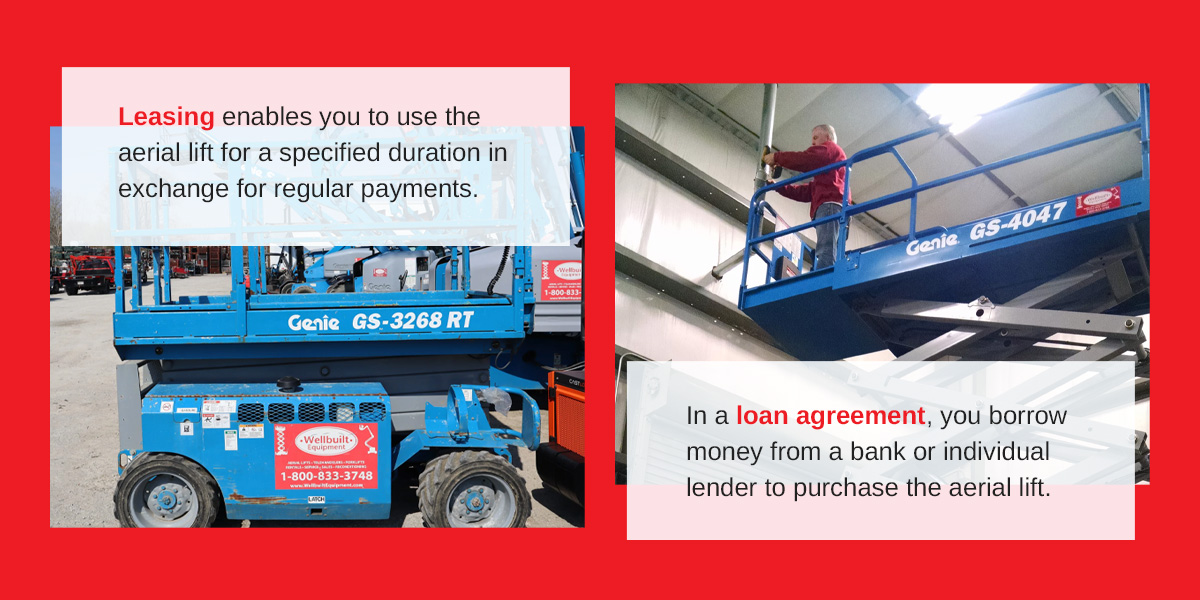
You have a few possibilities when financing aerial lift equipment. Some possible avenues are:
- Leasing: Leasing enables you to use the aerial lift for a specified duration in exchange for regular payments. Once your leasing period is up, you can either return the equipment, purchase it or upgrade to a newer model.
- Loans: In a loan agreement, you borrow money from a bank or individual lender to purchase the aerial lift. You repay the agreed-upon amount — plus interest — over a preestablished period.
Understanding Leasing Options for Aerial Lift Equipment
Leasing is typically the best course of action when you plan to use the aerial lift equipment for one to three years, as this is often how long the contracts last. It’s also ideal if you don’t have cash on hand for a down payment. A lease could also be a more sensible alternative to buying if your business is growing rapidly. There are multiple forms of equipment leasing, such as:
- Operating lease: An operating lease is a short-term agreement where you rent equipment for a set period. This duration is usually shorter than the equipment’s operational life. An operating lease typically covers servicing, maintenance and insurance. This option is suitable if you need an aerial lift for a limited time or a specific project.
- Sale and leaseback: A sale and leaseback is a financial agreement where a business or individual sells a piece of equipment and then leases it back for an extended duration. In other words, they can use the equipment but no longer own it. A sale and leaseback agreement allows a business to convert capital tied to owned equipment into usable funds.
- Capital lease: Also called a finance lease, a capital lease lets you use equipment for a specified duration. It also gives you the option of purchasing the equipment at the end of the term. Unlike an operating lease, you may also be responsible for equipment maintenance and insurance. If you need an aerial lift long-term or eventually plan to purchase one, capital leasing could be a feasible solution.
Understanding Debt Financing
Debt financing involves borrowing money from a bank or individual lender and repaying it later. A form of debt financing — such as a standard line of credit or bank loan — is likely more practical than leasing if you plan to use the equipment for three years or longer.
There are various types of debt financing, including:
- Bank loans: As the name suggests, a bank loan is a type of debt financing where an individual or business borrows money from a bank. This loan usually includes regular installments and fixed interest rates over a set term. Banks often assess the financial situation of the individual or company before offering loan amounts and interest rates accordingly.
- Lines of credit: A line of credit is a flexible loan from a bank or financial institution. It gives your business a revolving credit facility specifically for purchasing equipment. You can access funds when necessary and repay them over time. If you consistently require equipment replacements or upgrades for your projects, a line of credit makes sense.
The Benefits of Website and Online Services for Financing
When financing your aerial lift equipment, online services offer a simpler alternative to conventional in-person banking methods. Here are some ways online tools can streamline the equipment financing process:
- Accessibility: Digital platforms make it seamless to access and monitor your financial accounts, activities and data. Tasks like managing business finances, transferring funds and reviewing transactions are easier than ever. You can access this information in real time. As a bonus, you can skip the extra paperwork and unnecessary visits to brick-and-mortar institutions, saving considerable time and effort.
- Security: Online financial tools usually implement robust security measures to safeguard sensitive user data. These measures include multifactor authentication, encryption and secure data storage. You can also receive alerts for suspicious account activity and report them as needed.
- Cost savings: Online financial services minimize the expenses that accompany traditional baking. You can skip the added fees from in-person transactions, checkbooks and paper statements. Many virtual platforms also provide rate discounts, reduced fees and competitive interest rates to help customers save money.
Explore Our Financing Options at Wellbuilt Equipment Inc.
Navigating equipment purchases and payments can seem daunting. Fortunately, Wellbuilt Equipment Inc. can make the process smoother. In addition to our aerial lifts for rent and purchase, our flexible financing and leasing program can help you obtain the equipment you need on your terms.
Browse our selection of aerial lift equipment and explore our financing options today. Feel free to contact us if you need assistance or have questions.


Spider Lifts vs. Traditional Boom Lifts: Which Is Right for You?
November 30, 2023
An aerial lift is a must-have machine for any task involving elevated, difficult-to-reach areas. It helps workforces complete jobs safely and efficiently. Many industries rely on this type of equipment, including:
- Construction
- Manufacturing
- Warehousing
- Media and advertising
- Power and electricity
- Mining
- Oil and gas
- Landscaping
Aerial lifts come in numerous configurations, suiting them to different tasks and functions. Therefore, you have a few options to choose from if you’re in the market for an aerial lift. This guide will dive into spider aerial lifts and traditional boom lifts. We’ll explore the benefits, disadvantages and standard uses of each type, helping you make the most informed decision between the two.
What Are Spider Lifts?
Also called “compact tracked lifts,” spider lifts are lightweight, track-operated aerial lifts. They are designed for maneuvering high elevations and hard-to-reach spots, like narrow alleyways and uneven ground.
You can also work on steep inclines within the manufacturer’s gradeability limit. Remember — you should never attempt to raise or extend the boom while on sloped terrain. Only do so on firm, level ground.
A spider lift resembles a traditional boom lift but has a smaller base with four legs or outriggers that hold it firmly to the ground, giving it additional stability. Conversely, regular boom lifts typically have wheels.
Spider lifts can serve both indoor and outdoor applications, seamlessly reaching areas with overhead obstructions and accessibility challenges. Their outreach can exceed their height, letting them work around buildings, trees and other obstacles. Because they help work crews reach areas unobtainable by other machinery, spider lifts are ideal for the following tasks:
- Cleaning windows and gutters
- Painting buildings
- Installing and maintaining roofs
- Trimming and pruning trees
- Installing and maintaining cables, pipes or ducts
- Setting up lighting towers and temporary stages for outdoor events and concerts
- Reaching high-hanging lights and signs in stadiums, auditoriums, gymnasiums and other tall interiors
There are three types of spider lifts:
- Standard: Standard spider lifts run on fuel.
- Electric: Electric spider lifts operate using electrically charged batteries, allowing them to work indoors without pollution concerns.
- Hybrid: Hybrid spider lifts use a mix of electricity and fuel.
These lifts also vary depending on their uses and capabilities, like what heights they can reach. Whether construction projects, landscaping tasks or aerial advertising, spider lifts are a staple for nearly any job that requires aerial work.

What Are Traditional Boom Lifts?
A boom lift — also called a “man lift,” “telehandler,” “cherry picker,” or “basket crane,” among other things — is an aerial lift that can reach elevated heights. It has an attached work platform and hydraulic arm that moves the platform up and down.
There are two main types of boom lifts:
1. Articulating Boom Lifts
An articulating boom lift has an arm with pivot joints or knuckles, letting it bend in multiple directions. That’s why they’re often called “knuckle lifts.” The arm’s base is mounted to a turntable, enabling it to make a full circular rotation.
These features give the articulating boom lift more flexibility than its telescopic counterpart. It can reach tighter and more challenging areas, bending around beams and corners with ease. It can also accommodate both indoor and outdoor workspaces.
Due to its narrow and lightweight nature, articulating boom lifts can assist workers with the following tasks:
- Repairing power lines and streetlights
- Washing windows on a high building
- Cleaning gutters
- Performing electrical and piping repairs
- Painting walls and ceilings
- Hanging signs and lights
- Cutting, trimming and picking fruit from trees — hence why it’s often called a “cherry picker”
- Lifting shingles onto roofs
Articulating boom lifts and spider lifts are quite similar in their construction. You can see that they have many of the same uses. The main difference is that standard articulating boom lifts use wheels, while spider lifts have tracks and outriggers. Articulating boom lifts can also reach greater heights.
2. Telescopic Boom Lifts
A telescopic boom lift has an extendable arm, allowing it to reach various heights. Unlike its articulated cousin, however, it has a straight, nonarticulated mast attached to a rotating turntable. This mast can only extend in a straight line and swing into position rather than bending in different directions. For this reason, telescopic boom lifts are also referred to as “straight-mast lifts.”
This type of lift has an exceptionally long reach. It usually has a small bucket that holds one or two people at once, suiting it to specialized tasks by a single worker, such as:
- Trimming trees
- Performing electrical repairs
- Painting
- Inspecting buildings
You can find diesel-powered models with inflated tires for rough outdoor terrains and electric models with solid tires for indoor applications. Telescopic boom lifts are great for reaching multi-story buildings in large open spaces.
However, they’re often less ideal for worksites with limited space. Still, most telescopic boom lifts can reach greater heights than articulating boom lifts.
The Benefits of Spider Lifts
Spider lifts have many advantages that make them a go-to for work crews. Below are the different benefits spider lifts can bring to your job site.
1. Small and Lightweight Design
Spider lifts are compact and light, allowing them to fit through standard doorways, navigate tight spaces, climb steep slopes and maintain stability on irregular surfaces. You can work in various terrains and job sites, maneuvering to stable, comfortable and convenient positions to perform aerial tasks.
You can tow most spider lifts behind pickup trucks due to their lightweight nature, simplifying transportation immensely. Their compact design also makes them easy to store when not in use.
2. Efficiency
Spider lifts have numerous qualities that can help increase productivity and efficiency on your worksite:
- Compact and lightweight construction
- Seamless maneuverability and accessibility
- Ability to navigate different spaces, job sites and surfaces
- Low ground pressure
- Variable-width outriggers and rubber tracks for stability
You can experience more uptime and greater customer satisfaction due to the ability to complete jobs faster.
3. Safety
Spider lifts have a range of features to improve safety on your job site, such as:
- Stabilizers: Spider lifts’ outriggers keep the platform stable on uneven surfaces, providing an extra security layer for aerial workers.
- Auto-levelers: Many spider lift models have auto-leveling capabilities. This feature helps operators set up without guesswork, even on irregular terrain.
- Durable components: Despite being compact and lightweight, spider lifts are strong and robust, protecting the equipment against falling branches and other debris.
Remember that safety features on their own aren’t enough — your team should undergo extensive safety training to ensure they operate the lift properly.
4. Versatility
Spider lifts can tackle a variety of tasks, allowing you to complete a wide array of jobs. They also have a low ground pressure, letting them work on soft or uneven surfaces without inflicting damage. For these reasons, spider lifts are used across multiple industries, including landscaping, facility maintenance, stadium upkeep and construction.

The Benefits of Traditional Boom Lifts
Next, let’s look at some worthy advantages of traditional boom lifts.
1. Extensive Reach
Telescopic and articulating boom lifts tend to excel at greater heights than other types of lifts. Many traditional boom lifts can reach heights up to 185 feet or more. In comparison, a typical scissor lift can only reach heights of just under 60 feet. This type of lift only moves up and down and doesn’t have any horizontal reach.
All boom lifts have a horizontal reach to some degree, so you’ll need a boom lift for any task you cannot access vertically. However, scissor lifts tend to have larger platforms than both spider lifts and traditional boom lifts, allowing them to accommodate more workers and materials at a time.
2. Versatility
Like spider lifts, traditional boom lifts can suit multiple tasks, jobs and worksites. Boom lifts let you work at impressive heights and perform several functions, such as cleaning buildings, installing windows, fixing power lines and putting up stages for outdoor performances.
3. High Weight Capacity
Many traditional boom lifts can comfortably handle material loads of up to 500 pounds. This makes them suitable for heavy-duty tasks, like bringing large bundles of shingles up to a roof. They can also retain optimal stability while carrying these hefty loads.
4. Outreach and Over-Obstacle Capabilities
Due to their impressive height-reaching capabilities, traditional boom lifts — especially telescopic models — are ideal for tasks that require extended horizontal and vertical outreach. You can also move over different obstacles with ease. For instance, articulating boom lifts are often used to perform inspections since they can easily move over parking structures and other stationary obstacles.
Here are some other examples:
- Fire and rescue operations: Boom lifts can help rescue crews reach elevated heights safely and quickly. They can transport equipment, firefighters and victims in emergencies. For instance, a boom lift might help rescue individuals trapped on the top floor of a burning building.
- Warehousing: Boom lifts can assist personnel with tasks like stocking and retrieving inventory on high racks or shelves.
Disadvantages of Spider Lifts
While spider lifts have many perks and features, it’s also important to note some of their drawbacks.
1. Height and Reach Restrictions
As mentioned above, most boom lifts can reach heights of 185 feet or more. Meanwhile, many spider lift models can only reach heights of just over 75 feet when fully extended. This makes traditional boom lifts better for higher-reach applications than spider lifts.
2. Payload Limitations
Spider lifts tend to have more weight limitations than traditional boom lifts due to their compact, lightweight design. Of course, payload capacity — the maximum weight an aerial lift can safely carry — will vary depending on the model you choose.

Disadvantages of Traditional Boom Lifts
Traditional boom lifts have various features that make them a worthy addition to your job site. Like spider lifts, however, they also have a few limitations.
1. Storage and Transportation Challenges
Most traditional boom lifts are considerably heavier than spider lifts. To put it in perspective, spider lifts typically fall in the range of 6,000 to 9,000 pounds. Meanwhile, a traditional boom lift might weigh anywhere from 10,000 to over 30,000 pounds.
Naturally, traditional boom lifts’ bulky, heavyweight design makes them far more difficult to store and transport. Fortunately, you can always consult a professional for these services if you don’t have the means to store or transport your boom lift.
2. Limited Accessibility
Between their weight and extensive reach capabilities, traditional boom lifts can pose some challenges when working in tight, confined spaces. Spider lifts are better for maneuvering smaller spaces and moving between obstacles.
For instance, if the job requires you to navigate around trees, through doorways or into slender alleys, a traditional boom lift may not be practical. If you’re thinking of renting or purchasing a traditional boom lift, it’s important to invest in a model that accommodates your workspace.
Your boom lift should comfortably move, turn and fit around other pieces of equipment. If you’re working with uneven or rough terrain, make sure you choose a boom lift with larger, more durable tires for better maneuverability.
When to Choose Spider Lifts
To recap, we’ll look at the best use cases for spider lifts and traditional boom lifts to help you make the most feasible decision. You could benefit from a spider lift if you frequently work in the following environments:
- Confined areas: Spider lifts have rubber tracks that help them maneuver confined, hard-to-reach spaces while maintaining excellent traction.
- Fragile surfaces: Spider lifts won’t scuff up flooring or leave behind unsightly marks and scratches. They also won’t dig up and damage outdoor surfaces like soil and grass. Therefore, spider lifts are well-suited to worksites with fragile surfaces, such as lawns and indoor spaces. You can also use this equipment on uneven surfaces, like hills, gravel and raised sidewalks.
- Indoor spaces: You can easily use spider lifts inside shopping centers, theaters, schools, hospitals and other tall structures. The platform basket can safely transport workers and materials around corners, along walls, up to ceilings and through other compact spaces.
When to Choose Traditional Boom Lifts
On the other hand, you may prefer a traditional boom lift in these situations:
- High-reach tasks: If a job requires you or other crew members to work at heights over 75 feet, it makes more sense to rent a traditional boom lift than a spider lift. Traditional boom lifts are great for high-reach requirements, such as working on tall trees, cathedrals and multi-story buildings.
- Heavy-duty construction projects: Traditional boom lifts are bulky and heavyweight, making them ideal for projects in vast, open spaces. They’re well-suited to residential, commercial and industrial construction projects that require ample space, materials and personnel. These heavy-duty machines can lift large material volumes up to elevated surfaces.
- Over-obstacle requirements: Traditional boom lifts are fantastic for over-obstacle applications, as well as horizontal and vertical outreach tasks. They’re great for performing building inspections, maintenance, installations and repairs, among many other jobs.

Find the Right Aerial Lift for the Job at Wellbuilt Equipment Inc.
Now that you know the best uses of spider lifts versus boom lifts, you can select the right type for your unique requirements. At Wellbuilt Equipment Inc., we have both spider lifts and traditional boom lifts available for rent and purchase.
Since 1987, our mission has been to provide the public with safe, efficient machinery. We’re your one-stop-shop for all things aerial lifts, including sales, rentals, repairs, inspections and maintenance. We also offer free on-site estimates and flexible financing options, making it even simpler to get the solutions you need.
Find the aerial lift you’re looking for from our high-quality equipment selection. Browse our extensive inventory, then contact our team to discuss your renting or purchasing needs today!
Read More
The Ultimate Guide to Choosing the Right Spider Lift for Your Projects
November 29, 2023
A spider lift, also called a spider boom lift, is an elevating work platform with stabilizer legs for steadiness and leveling to access hard-to-reach spaces. This specialized equipment can help improve your team’s productivity and make your workspace safer. As a result, you’ll want to weigh several factors to choose the best type and model for your company. The appropriate spider lift will assist in worker safety and align with your job requirements and constraints.
In our guide, we’ll discuss all you need to know about spider lifts so you can choose the best one for your operations.
What Are Spider Lifts?
Spider lifts can access confined or challenging spaces where traditional equipment might not fit. They take their name from the various articulated sections and extendable outriggers that resemble a spider’s legs. Three types of spider lifts include the following.
- Telescopic lifts: These lifts have a rotating base and a straight, extendable boom with a long reach. The arm movement extends and retracts in one direction, allowing operators to reach higher places with plenty of space.
- Articulating lifts: These spider lifts feature multiple joints in their booms, allowing operators to reach heights while offering greater flexibility than telescopic lifts.
- Crawler lifts: Crawler spider lifts come with rubber or steel tracks that contribute to lower weight and help operators move around on rugged terrain.
Each type of spider lift comes with articulating booms, extendable outriggers, hydraulic systems, versatile platforms, compact designs and remote controls for elevated access.
Assessing Your Project Needs
Before choosing a spider lift, you’ll want to determine your project’s scope and nature. Here are some essential factors to account for.
- Height: What maximum height can your chosen machine reach when fully extended? Most spider lifts range from 50 to over 100 feet, so select the model with the appropriate height for your specific job.
- Outreach: You’ll also want to consider the spider lift’s outreach, or how far horizontally it can extend. Some can extend up to 60 feet, making it essential to consider if you’re working with an unusually shaped building or structure.
- Terrain and site conditions: Where will you use your spider lift? Some models can handle rough terrain, while others are better for flat surfaces.
- Weight and capacity limits: Consider the maximum weight your spider lift can safely elevate and hold. Ensure your chosen model’s weight capacity aligns with your job requirements.
Safety Considerations
You must have OSHA certification to know how to conduct safety inspections for your spider lift and use it properly. The right processes can help you increase your equipment’s longevity and prevent unnecessary wear and tear. Skipping inspection can be dangerous and impact your bottom line due to expensive OSHA fines.
- Conduct ANSI and OSHA standard inspections: Review the OSHA operator guidelines and safety standards to inspect your equipment. It’s best to perform initial, frequent and annual inspections to ensure the equipment has no defects and is operating safely.
- Look for specific safety features: Choose a spider lift with the proper safety features. For instance, the mechanical fasteners and locking pins should be in place, and the outriggers and stabilizers must be in working condition. Check for fluid leaks and ascertain the wheels and tires are at their minimum PSI limit. Lastly, look over the steering wheel, brakes, emergency controls and air, fuel, electrical, hydraulic and insulating components.
- Invest in operator training and certification: OSHA certification will train workers to use the equipment following safety standards and know when a machine has reached its limits. Meet OSHA standards to protect your workers and prevent fines or project delays.

Choosing the Right Spider Lift
When selecting a spider lift for your task, think about factors like lift specifications, models and brands, user feedback and cost.
Matching Lift Specifications With Project Requirements
Ensure your aerial work platforms meet your project requirements, including outreach, type, height and weight specifications.
Comparing Different Spider Lift Models and Brands
Consider popular lift brands in the industry right now, such as:
Compare these brands and their different models to help you determine the right spider lift for your task.
Reviewing User Feedback and Recommendations
You must review user feedback to ensure your chosen brand and model will perform as needed. Check with a reputable equipment provider and ask for recommendations. The best provider will have an extensive selection of top-quality equipment and parts for rent or purchase. Search for a provider that can provide expert service and lift recommendations based on your project requirements.
Cost Considerations and Budgeting
Consider your budget and needs to choose the correct spider lift. Your equipment cost can differ based on the following:
- Type and height
- Diesel, electric, battery or dual-power operator source
- Number of rental days
- Type of task
- Indoor or outdoor use
- Heavy or light-duty operations
Renting vs. Buying
It’s best to consider your project duration and budget before renting or buying a spider lift.
For instance, renting your spider lift can offer more flexibility and cost savings for short-term projects, as it doesn’t require a long-term investment. You can also appreciate maintenance coverage, a lower upfront cost and access to new models. However, rental prices can accumulate if you use your equipment for extended projects.
Buying a spider lift is ideal for long-term projects as it offers asset value and customization options. Pros include long-term savings and equipment availability. However, you’ll pay a higher upfront cost and ongoing maintenance expenses.
Maintenance and Service
Regular maintenance can extend your equipment’s life span while ensuring it runs efficiently. Create a routine inspection and maintenance schedule, clean it properly, check for signs of wear and tear and store it properly.
Check your equipment’s warranty and after-sales service to ensure you can get proper maintenance or repairs as needed. Find a reliable service provider that offers prompt services so your equipment always operates to the best of its abilities.
Case Studies and Real-Life Examples
Spider lifts can help with various projects, offering many benefits when successfully implemented. For instance, your team might use a spider lift for exterior building maintenance to prevent costly repairs and address issues before they worsen.
Other examples include:
- Tree trimming and removal
- Window washing for skyscrapers
- Telecom tower repairs
- Orchards and vineyards
- Stadium light maintenance
- Bridge inspection and maintenance
- Power line maintenance
Spider lifts can provide precise access to elevated areas, enhancing safety and efficiency for various projects.

Empower Project Success With the Right Aerial Access Equipment
A reliable spider lift can help you complete jobs more efficiently and safely when working at heights. You’ll want to find a safe model and train your employees to maximize the equipment’s potential.
At Wellbuilt Equipment Inc., we can help you find the right equipment and provide training resources to ensure you use it effectively. Our wide selection includes new and used equipment aerial work platforms and rental options.
Contact us to learn more about our equipment or consult with our team.
Read More
The Benefits and Uses of the CTE 230-75 Spider Lift
October 24, 2022
When searching for a new spider lift, the CTE 230-75 can greatly assist contractors and organizations. We’ve outlined this equipment’s functions, benefits and safety procedures, so you can determine if it is right for you.
The CTE 230 Overview
The CTE 230 is a powerful spider lift that increases stability and specializes in reaching hard-to-access locations. The extendable platform can reach over 75 feet in height, and the telescopic boom has a 39-foot outreach, helping your teams work on ceilings, roofs and other elevated systems. The 320° rotation offers more control to operators, allowing them to maneuver as they need to reach every aspect of your job site.
This spider lift can hold around 440 pounds, enabling your operators to bring all necessary tools while working. You can extend the tracks’ width to match your functionality and increase stability on your job sites. With hydraulic and electric power, the CTE 230-75 is a significant asset to all industries.
Spider Lift Benefits
When looking for the best solutions and equipment, telescopic boom and spiders lifts can offer several benefits to users, including:
- Stability: CTE lifts can navigate uneven terrains, making them ideal for outdoor applications. Their stability ensures operator safety while protecting the equipment’s functional integrity.
- Efficiency and flexibility: Because this equipment has so many applications, your teams can devote more time to projects by carrying out several functions with one tool.
- Reach: The telescopic boom’s increased reach and rotation capabilities make it possible for you to work in more hard-to-access places. You can provide more comprehensive care at your job sites by accessing all areas.
- Safety: The CTE’s various safety features and procedures allow you to protect your operators better. These processes offer increased control and a higher understanding of how your tools work.
- Compact and lightweight: The CTE spider lift is compact and lightweight, so it can navigate tighter spaces and take up less room. This option increases its functionality and helps reduce the impact on facility owners and public spaces while working. Its lightweight design enables functions indoors without damaging floors.
When investing in a CTE lift, understanding the benefits can help you decide if this model suits you and your applications.
Common Industry Uses of Spider Lifts
CTE spider lifts are versatile and innovative technical solutions, so several industries can use them. They function well in indoor and outdoor settings because of their lightweight and compact capacities, and their increased stability and strong tracks allow them to transverse uneven ground. Some standard applications include:
- Construction: Many construction and contractor teams integrate CTE lifts into their operations because they are versatile. Whether your company is working on residential or industrial projects, spider lifts can offer the reach and stability needed for several applications, from roof installations to bridge repairs. Because they are compact, construction companies can use them in neighborhoods and cities without occupying too much space.
- Installations: When installing HVAC systems or fire prevention equipment, spider lifts can help you reach high ceilings and access points, like shopping malls or warehouses. Their stability allows you to operate carefully, so you can access your electrical system or air ducts.
- Maintenance: After installing equipment, your CTE lifts can also help maintain their quality and functionality. Their extended reach helps maintenance teams access HVAC ducts to fix problems and run tests. You can also use spider lifts to access many other systems, from electrical and telephone wires on telephone poles to wind turbines.
- Cleaning: Many buildings have particular aesthetic standards they like to maintain. CTE spider lifts can help facilities and cleaning teams reach high glass windows or corners. The compact, lightweight capabilities of this equipment prevents floor damage. You can also use this option when painting walls or ceilings for increased control over your building’s visual elements and appeal. Exterior applications can help buildings and homes clear gutters and clean roofs.
- Landscaping: CTE lifts are great at clearing tree branches. Because they can navigate uneven terrains, your landscaping teams can easily access trees for more steady jobs. Whether clients want to eliminate dead branches or trim unruly trees, spider lifts allow your team to deliver.
With so many more applications, the CTE spider lifts can adapt to many needs, making them excellent tools for businesses to purchase and rent.

CTE Built to Last With Unparalleled Industry Safety
The CTE 360 is durable, making it an excellent investment for many industries and companies. Its safety features add to its longevity and life span, ensuring you can continually depend on your spider lift. The equipment’s remote gives the operator extensive functionality and safety procedures, so they can maintain control even when in the basket.
The features allow you to use multiple functions simultaneously while keeping the same speed and security. The CTE functions with diesel and electric power, and you can switch between the two to match your location for optimal safety.
For more information on how to operate a CTE 360, check out our operation walkthrough and start-up procedure demonstration.
Emergency Control Ease of Use
The CTE 360-75 offers extensive emergency controls, allowing your operators and teams to control rigging configurations and movement from the ground. These functions can help your equipment maneuver indoor and outdoor terrains to fit in tight spaces and safely navigate job sites.
You can find the emergency controls on a panel on the side of the equipment at ground level for best access. It includes a diagram beside it to remind operators how each component needs to move for proper practices and procedures when using these controls. Your operators can carry out each operation with just knobs and buttons for simple functions that are easy to control and manipulate.
You can watch how to engage the emergency controls with a walkthrough from one of our experts.
Emergency Track Controls
The emergency track controls allow you to expand and retract your tracks for increased width control and functionality.
Wellbuilt Equipment Inc. also offers instructional videos on other emergency controls, including:
Emergency Outrigger Controls
The emergency outrigger controls enable operators to move the outriggers up and down.
Emergency Swing Outrigger Controls
This video explains more about how to move your outriggers. The emergency swing outrigger controls expand and retract the arms, moving them farther or closer to the machine.
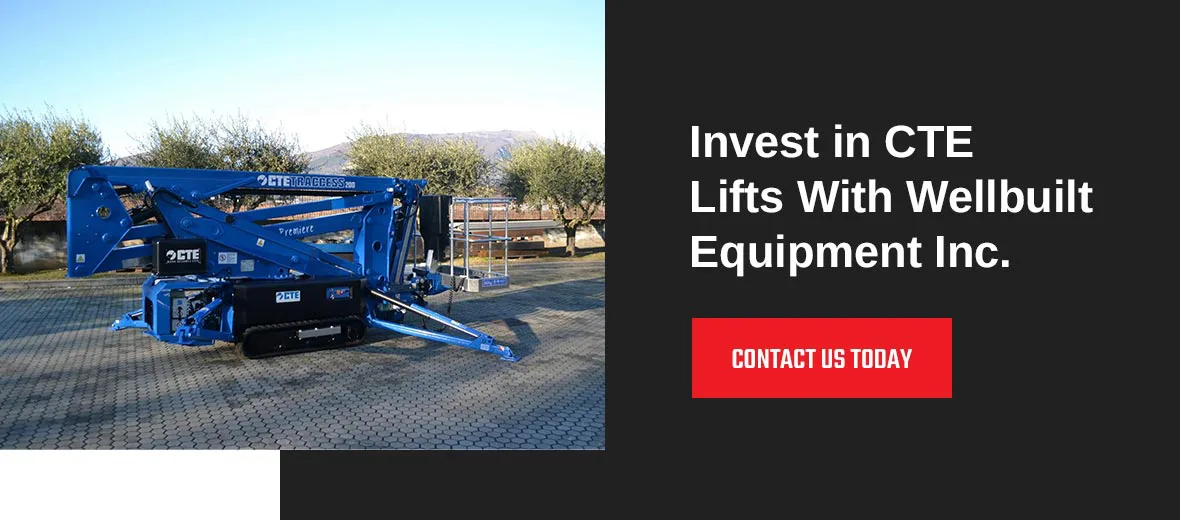
Invest in CTE Lifts With Wellbuilt Equipment Inc.
Learning about CTE lifts and their benefits can help businesses and contractors understand if this equipment is a suitable fit for your operations. Because of its heightened safety features and applications, the CTE 230-75 can positively impact your job site operations.
Wellbuilt Equipment Inc. sells and rents quality machinery and parts to companies and contractors across industries. Our quality customer service team helps match customers with the equipment that will best serve them from our extensive inventory. Free on-site estimates and a simple invoicing process help you focus on your daily operations.
Explore our selection of new and used CTE 230 spider lifts from Wellbuilt Equipment Inc., or contact us today to discover how they can transform your job site.

Trash Rockets vs. Debris Chutes
September 21, 2022
Trash Rockets vs. Debris Chutes
A trash vessel is crucial for disposing of large amounts of debris. Workers in industries like construction and roofing need safe ways to remove trash from rooftops, sidewalks or other areas. It’s important to keep both employees and passersby protected from falling trash, and with a construction zone that’s free of debris, workers can work more productively.
Many construction sites use debris removal tools to get rid of excess materials. Options like debris chutes and Trash Rockets efficiently remove the trash. But what are the differences between Trash Rockets and debris chutes, and which option is better for your site?
Read on to learn more about Trash Rockets vs. debris chutes.

What Are Debris Chutes?
First, debris chutes are one option for removing trash from sites. These apparatuses allow for swift and thorough trash removal. Shaped like long tunnels, trash chutes run from the top of roofs or construction sites and connect safely to a trash container below.
Debris chutes allow for safe passage of trash and construction materials. Workers can remove objects and waste without endangering themselves, nearby walkers or surrounding equipment. The trash moves from the site directly into the dumpster on the ground level.
All debris chutes must follow OSHA guidelines, such as:
- Contractors must install a gate at the end of the chute, and a trained employee must operate it at all times.
- Guardrails must protect chute openings by at least 42 inches above the floor.
- Workers must securely close the discharge area when operations aren’t in progress.
Most chutes are simple to install and disassemble, making them easy to transport between construction or roofing sites. You can split the chutes into multiple pieces during travel, then assemble them when it’s time for use.
Debris chutes can consist of different materials, including:
- Steel: Many construction sites use steel materials to get rid of heavy construction materials. Steel allows heavy-duty objects to safely pass through without damaging the tube or the surrounding environment.
- Plastic: Plastic chutes are well-suited for light-duty construction or renovation jobs. Because plastic isn’t as durable as steel, workers typically use this type with lighter construction materials.
For debris chute rentals please visit our International Scaffolding Equipment website.

What Are Trash Rockets?
Trash Rockets are another type of debris mover. These tools are slightly different from trash chutes in that they don’t require a connection to a dumpster. Instead, Trash Rockets launch debris into the dumpster from a distance.
Scott Seaton, the founder of Rocket Equipment, was the first manufacturer of Trash Rockets. He faced a tough dilemma when working on a construction site with concrete materials. He soon realized that dropping the heavy tiles from the roof would harm the surrounding landscape. In response, Seaton developed Trash Rockets. These tools are highly durable and shoot debris safely over the nearby landscape and into trash receptacles.
You can place Trash Rockets up to 32 feet away from dumpsters and they can reach heights of 39 feet. The tubes are entirely enclosed, safely moving debris away from your construction site. You can move Trash Rockets between construction sites easily via trailer or other transport. And because they feature corrosion-resistant properties, Trash Rockets last for many years.
Pros and Cons of Each
It might be challenging to decide between Trash Rockets and debris chutes. Both of these commercial-grade trash chutes have benefits and drawbacks that might help you make your decision.
Trash chutes have many pros, such as:
- Safety: All trash chutes must follow OSHA guidelines. These ensure safety for construction workers, nearby buildings or anyone else near the construction site. Excess construction materials like glass or nails could injure workers or trip them, leading to injuries and falls. Trash chutes protect anyone that is working onsite from hazards due to debris and trash.
- Improved productivity: Cleaner construction sites let employees increase efficiency. It’s easier to access construction site areas without trash taking up space.
However, a dumpster chute might also have drawbacks like:
- Maintenance: Trash chutes require consistent maintenance for use. If materials get lodged somewhere in the chute, you might have to pause work until the chute is safe to use again.
- Needs connection to dumpster: You need a nearby dumpster or trash receptacle to use a trash chute. The proximity to the sidewalk and landscape could be potentially damaging.
On the other hand, Trash Rockets have advantages like:
- Increased efficiency: You can set up a Trash Rocket in as little as fifteen minutes, and usually with only one person. The easy setup allows you to get started on your construction work sooner.
- Cost-effective: A Trash Rocket guarantees you won’t come into contact with the landscaping or sidewalk at your construction site. It shoots debris over these areas, minimizing the chance you’d need to make costly repairs.
But they also have cons:
- Unfamiliarity: Your crew might not have the same familiarity with this product that they do with typical trash chutes. An unfamiliarity might make it more challenging to use at first.
- Accessibility: Because Trash Rockets are more unique products, it might be harder to acquire one. If your construction site is in a remote location, it could be more challenging to find a dealer.
Which One Is Right for You?
As you decide between these two roofing chutes, it’s helpful to consider your site’s circumstances. Both trash movers have different pros and cons that would impact your workplace.
Consider these factors as you decide:
- Site location: The key difference between the options is the Trash Rocket’s lack of contact with the surrounding landscape. If your site is nearby expensive landscaping or important sidewalks, you might consider using a Trash Rocket instead of a typical trash chute. However, if your surroundings are of less importance, a debris chute might be your best bet.
- Crew preferences: You should also think about your crew’s experience and preferences. If they have training with one tool or prefer one, you should take that into consideration. The more comfortable your crew is, the better their productivity will be.
Overall, both options are highly beneficial for construction sites.
Contact WellBuilt Equipment Today
At WellBuilt Equipment, we understand the necessity of safely removing debris for the construction industry. Since 1987, we have offered high-quality construction materials for sale and rent. We set apart from competitors with dedicated customer service and top-notch materials.
We offer a variety of debris removal tools, including Trash Rocket models. Whether you need to purchase one to use at all your sites or just want to rent one for a single project, we have availability for you. From high-quality tools to financing, we can help you in many areas.
Contact WellBuilt Equipment today to learn more about our trash removal products and other offerings.

Benefits and Uses of Palazzani Lifts
April 13, 2022
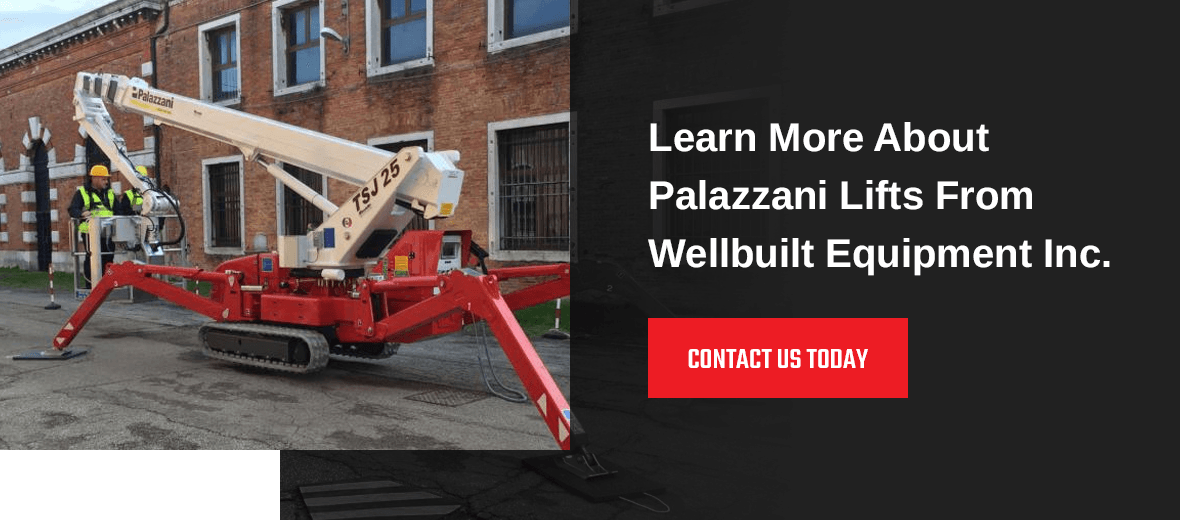
Compact tracked lifts are similar to standard boom lifts, except they feature four legs or outriggers that extend from the base to serve as supports. These legs create an insect-like appearance, which is how this type of lift got the nickname “spider lift.”
At Wellbuilt Equipment Inc., we rent, service and sell a wide variety of aerial lifts, including spider lifts from Italian manufacturer Palazzani. In this post, we’ll explain what sets Palazzani’s spider lifts apart from other comparable machines. We’ll also discuss typical applications for spider lifts to provide some insight into what makes these machines so powerful in real situations.

TZX 730
Weighing in at just 5,500 pounds, the TZX 730 from Palazzani is lightweight but mighty. Its maximum outreach is 33 feet with a maximum working height of 73 feet, which gives it unrivaled performance capabilities when compared to other machines in its price and size range. Plus, it has a minimum width of only 3.3 feet, so it can effortlessly slip into narrow spaces.
Here are just a few of the qualities that make the TZX 730 an excellent choice for your projects:
- Radio control: The TZX 730 comes with wireless remote control, making operation easy both inside and outside the basket.
- Smooth driving: The non-marking track drive system on the TSX 730 enables you to drive over any surface, including delicate floors, with precise movements. You can work both inside and out without risking the ground’s conditions.
- Small footprint: The aluminum boom construction allows the machine to be incredibly lightweight while still allowing for total outreach, enabling you to work in any size space.
- Unrivaled control: The individually rotating two-position outriggers allow for quick setup in confined areas, while the machine’s articulated arms with double telescopic extensions allow for maximum aerial agility.
- Intuitive operation: The TZX 730’s controls are simple and easy to learn, so even new operators will be able to get to work quickly and safely.
- Unparalleled stability: The TZX 730 has a maximum lift capacity of 440 pounds. The basket is incredibly stable, so you can perform your work without that uncomfortable floating feeling you might get on similar lifts.
The TZX 730 is currently available for sale from Wellbuilt Equipment Inc., so feel free to reach out with any questions.

TSJ 82
The TSJ 82 spider platform lift from Palazzani is slightly larger than the TZX 730 at just over 8,700 pounds, but it’s still small and compact compared to many similar machines.
Key features of the TSJ 82 include:
- Long reach: The TSJ 82’s single-arm telescopic boom with articulated jib gives the machine an impressive maximum outreach of 59 feet and a working height of 82 feet. It also provides an unmatched 44 feet of side reach at a height of 40 feet, setting it apart from other spider lifts in its size category.
- Impressive agility: With its articulated jib, the TSJ 82 is able to rotate 660 degrees at any placement and any height without any tail swing.
- Touchscreen technology: The TSJ 82’s innovative touchscreen terminal makes operation a cinch. The touchscreen prompts walk you through machine and outrigger setup, while the included diagnostic tool provides an easy way to monitor the health of all the lift systems with only a few taps.
- Easy operation: Like the TSX 730, the TSJ 82 comes with a wireless remote so you can control it from anywhere within range. The basket comes equipped with two joysticks that control all the machine’s movements. Plus, the machine has QR code labels that link directly to instructional videos — any time someone needs a refresher, they can just scan the label.
- In-basket power: The basket is fully equipped with air, water and electric capabilities, allowing you to complete various tasks like pressure washing and painting while in the air.
- Simple maintenance: The TSJ 82 is especially easy for mechanics to work on because all the lift’s internal systems are accessible from one point.
- Durability: With a 550-pound lift capacity and booms constructed from high-strength STRENX steel, the TSJ 82’s in-air stability is dependable for even the most demanding jobs. Valuable components like the hose are strategically placed inside the boom, which protects them from harm and keeps your equipment working longer.
If you’ve been thinking of introducing a spider lift into your fleet, consider renting the TSJ 82. You can try out the machine on your own worksite before you buy, which is advantageous for those who are new to spider lifts. We also offer the TSJ 82 for sale, so feel free to contact us with questions.
Industry Uses
Palazzani lifts are useful instruments for a variety of applications across many industries.
The most common use cases include:
- Forestry: The ability to drive and work on irregular terrain is why Palazzani’s spider lifts are great tools for working on uneven forest floors. Furthermore, they provide a secure platform to perform essential landscaping work in places ladders may be unsafe or inefficient.
- Building maintenance: In addition to being able to work on uneven ground, Palazzani lifts are highly maneuverable with zero tail swing even when working at heights. This property allows you to work both inside and outside without threatening elements like a business’s landscaping or a church’s pews.
- Restoration: The lift’s smooth, precise movements allow you to perform delicate restoration work without potentially causing damage to your surroundings. Plus, Palazzani lifts produce zero noise and exhaust fumes, which makes them suitable for work both indoors and outdoors.
- Construction: Many different interchangeable attachments are available for Palazzani lifts, making them suitable for a variety of construction applications like material handling, concrete mixing, snow removal and more.
- Agriculture: Palazzani lifts are a safe choice for farming applications due to their high weight capacity and incredible potential for performance. You can tend to fruit orchards and other high-growing crops with the peace of mind that your lift will support you.
- Ecology: Compactness is a strategic asset in ecological work because it enables you to get up close with the life forms you’re researching. The lightweight, compact TZX 730 is an excellent choice for efficiently supporting work in all sorts of natural environments.
Whether you’re restoring a cracked church facade or pruning diseased trees, Palazzani spider lifts can help you get the job done safely and smoothly.
Learn More About Palazzani Lifts From Wellbuilt Equipment Inc.
Spider lifts are an invaluable asset to worksites in various industries, from forestry to construction. At Wellbuilt Equipment Inc., we provide our customers with the highest quality aerial lifts from a variety of brands, including Palazzani.
Are you interested in learning how a Palazzani spider lift can benefit your operations? Reach out to us today for more information and you can speak directly with a knowledgeable human representative.
Read More